
Anúncios
Learning guitar has never been more accessible, thanks to innovative mobile apps designed to guide beginners and intermediate players through their musical journey with interactive lessons and instant feedback.


The digital revolution has transformed how we approach learning musical instruments. Gone are the days when aspiring guitarists had to rely solely on expensive private lessons or thick instruction manuals.
Anúncios
Today’s guitar learning apps combine cutting-edge technology with proven teaching methods to create personalized learning experiences that adapt to your pace and skill level.

Whether you’re dreaming of playing your favorite songs around a campfire or aspiring to become a professional musician, the right app can make all the difference.
Anúncios
These tools offer structured courses, real-time feedback, and the flexibility to practice whenever and wherever inspiration strikes. Let’s explore what makes these applications so effective and how to choose the perfect one for your musical ambitions.
🎸 Why Choose an App to Learn Guitar?
Traditional guitar lessons typically cost between $30 to $60 per hour, which can quickly add up to hundreds or thousands of dollars annually. In contrast, most guitar learning apps offer monthly subscriptions ranging from $10 to $20, with many providing free trial periods.
This accessibility opens doors for countless individuals who might otherwise never pick up an instrument.
The convenience factor cannot be overstated. With a smartphone or tablet, your guitar instructor lives in your pocket. Practice at 6 AM before work, during lunch breaks, or late at night when inspiration strikes.
There’s no need to coordinate schedules, commute to lessons, or feel rushed by time constraints.
Modern apps leverage artificial intelligence and audio recognition technology to listen to your playing in real-time. They provide immediate feedback on accuracy, timing, and technique—something even the most attentive human instructor struggles to do consistently.
This instant correction helps prevent bad habits from forming early in your learning journey.
📱 Key Features That Make Guitar Apps Effective
The most successful guitar learning applications share several core features that distinguish them from basic tutorial videos or static chord charts. Understanding these elements helps you evaluate which app aligns best with your learning style and goals.
Interactive Lessons with Audio Recognition
Advanced audio recognition technology listens through your device’s microphone as you play, analyzing pitch accuracy, rhythm, and chord transitions. The app provides visual feedback showing which notes you played correctly and where improvements are needed.
This technology has become remarkably sophisticated, accurately detecting individual strings and fret positions even in noisy environments.
The best apps gamify this feedback system with points, streaks, and achievement badges that motivate consistent practice.
You’ll see your progress quantified through completion percentages and skill ratings, creating satisfying milestones that keep you engaged during challenging phases.
Structured Curriculum from Basics to Advanced
Quality guitar apps organize lessons into progressive courses that build upon previous knowledge systematically.
Beginners start with fundamental concepts like proper holding position, basic open chords, and simple strumming patterns before advancing to barre chords, fingerpicking techniques, and music theory.
This structured approach prevents the common pitfall of jumping randomly between songs or techniques without developing a solid foundation.
The curriculum typically mirrors what professional guitar instructors teach, but with the flexibility to repeat lessons as many times as needed without judgment or additional cost.
Extensive Song Library
Learning becomes infinitely more enjoyable when you’re playing songs you actually love. Top guitar apps feature libraries containing hundreds or thousands of popular songs across multiple genres—from classic rock and country to pop, blues, and folk. These aren’t just chord sheets but interactive lessons that break down each song into manageable sections.
Many apps allow you to adjust playback speed, loop difficult sections, and see tablature synchronized with audio playback. This multimodal approach—seeing, hearing, and playing simultaneously—accelerates the learning process significantly compared to traditional methods.
🌟 What to Look for When Choosing Your Guitar Learning App
With dozens of guitar apps available across iOS and Android platforms, selecting the right one requires consideration of several important factors beyond just price and popularity ratings.
Your Current Skill Level and Goals
Some apps specialize in absolute beginners, offering extensive hand-holding through the earliest stages of guitar playing. Others cater to intermediate players looking to expand their repertoire or learn specific techniques like fingerstyle, improvisation, or music theory.
Identify where you stand now and where you want to be in six months or a year.
If you’re starting from zero, prioritize apps with comprehensive beginner courses that don’t assume any prior musical knowledge. Look for content explaining how to read tablature, tune your guitar, and develop proper finger positioning.
More advanced players should seek apps offering genre-specific courses, scale exercises, and theory lessons.
Learning Style Compatibility
People absorb information differently. Visual learners benefit from apps with high-quality video demonstrations showing finger placement from multiple angles.
Auditory learners need clear audio examples and detailed verbal explanations. Kinesthetic learners thrive with apps emphasizing interactive exercises and play-along features.
Most quality apps incorporate all three modalities, but their emphasis varies. Download free trials of several options to determine which teaching style resonates most naturally with how you learn best.
Practice Tools and Extras
Beyond core lessons, valuable supplementary features enhance your learning experience. Look for built-in tuners, metronomes, and chord libraries you can reference anytime.
Some apps include backing tracks that let you practice lead guitar over rhythm sections, simulating the experience of playing with a band.
Progress tracking features help you maintain motivation by visualizing improvement over time.
Calendar views showing practice streaks, statistics on time spent practicing, and completed lesson counts all contribute to building consistent habits—the true secret to mastering guitar.
💡 Maximizing Your Success with Guitar Learning Apps
Even the most sophisticated app won’t magically transform you into a guitarist without consistent effort and smart practice strategies. Here’s how to extract maximum value from your chosen application.
Establish a Consistent Practice Schedule
Neurological research shows that shorter, frequent practice sessions yield better results than occasional marathon sessions. Aim for 15-30 minutes daily rather than cramming two hours on weekends.
This consistency strengthens muscle memory and neural pathways more effectively while fitting more easily into busy schedules.
Set specific times for practice—perhaps every morning with coffee or every evening after dinner. Treat these appointments as non-negotiable commitments. Enable push notifications from your app to serve as gentle reminders when life gets hectic.
Balance App Lessons with Free Play
While structured lessons provide essential guidance, dedicate time to unstructured exploration. Experiment with creating your own chord progressions, improvising melodies, or simply strumming familiar songs from memory.
This creative play develops musicality and prevents learning from feeling like pure obligation.
The ideal ratio varies by individual, but consider spending 70% of practice time on app lessons and 30% on free exploration. As you advance, gradually shift this balance toward more creative, self-directed playing.
Record Yourself Regularly
Your perception of your playing differs dramatically from how it actually sounds. Recording yourself weekly provides objective evidence of progress that can be encouraging during plateaus.
Many guitar apps include built-in recording features, or you can use your smartphone’s voice memo function.
Compare recordings from different weeks to hear improvements you might not notice in daily practice. This tangible proof of advancement provides powerful motivation to continue when challenges arise.
🎯 Common Challenges and How Apps Help Overcome Them
Every guitarist faces similar obstacles during their learning journey. Understanding these challenges and how modern apps address them prepares you for the road ahead.
Finger Pain and Building Calluses
Beginners universally experience fingertip soreness when pressing steel strings against frets. This discomfort is temporary but can discourage early progress.
Quality guitar apps acknowledge this reality by starting with shorter lessons and gradually increasing duration as your fingers adapt.
The apps encourage proper technique that minimizes unnecessary pressure, helping you develop calluses without excessive pain. Progress tracking features show you’re moving forward even during uncomfortable initial weeks, providing motivation to push through this temporary phase.
Chord Transition Speed
Moving smoothly between chords represents one of the most frustrating early challenges. Your fingers feel clumsy, transitions take forever, and maintaining rhythm seems impossible.
Apps address this through targeted transition exercises that isolate specific chord changes, allowing focused practice on problem areas.
Variable playback speeds let you master transitions slowly before gradually increasing tempo. This scaffolded approach builds competence systematically rather than leaving you struggling with full-speed songs before you’re ready.
Staying Motivated During Plateaus
Progress follows a nonlinear path with rapid improvement phases followed by frustrating plateaus where advancement seems stalled. Guitar apps combat this with diverse content—when chord practice feels stale, switch to learning a new song or exploring a different technique.
Achievement systems, progress badges, and community features create extrinsic motivation during periods when intrinsic motivation wanes. Leaderboards and social sharing options connect you with other learners, fostering accountability and friendly competition.
🔊 Complementing Your App with Additional Resources
While a quality guitar app provides comprehensive instruction, supplementing with additional resources accelerates learning and maintains engagement.
YouTube Channels and Online Communities
Thousands of skilled guitarists share free tutorials, technique tips, and song lessons on YouTube. These complement your app’s structured curriculum with diverse teaching styles and perspectives.
Search for channels specializing in your preferred music genres for inspiration and alternative explanations of challenging concepts.
Online forums and social media groups dedicated to guitar learning offer community support, answer questions, and provide encouragement.
Reddit’s guitar learning communities, Facebook groups, and dedicated forum sites connect you with fellow learners and experienced players willing to share advice.
Basic Music Theory Study
Understanding fundamental music theory—scales, intervals, chord construction, and keys—transforms you from someone who memorizes patterns into a musician who understands what you’re playing.
Many guitar apps include theory lessons, but supplementing with dedicated theory resources deepens comprehension.
This knowledge enables you to eventually learn songs by ear, write your own music, and communicate effectively with other musicians. You don’t need conservatory-level theory, but grasping basics makes advanced techniques more accessible.
Live Performance Opportunities
Nothing accelerates progress like preparing to perform for others, even if “performance” means playing for supportive family members. This deadline creates focused practice incentive and reveals areas needing improvement.
Local open mic nights, small gatherings, or even live-streaming provide valuable performance experience.
These real-world applications of your app learning transform abstract exercises into meaningful music-making, the ultimate goal of picking up a guitar in the first place.
🚀 Taking Your Skills Beyond the App
Guitar learning apps provide excellent foundations, but eventually, you might seek experiences they cannot fully replicate.
When to Consider In-Person Lessons
For most beginners through early intermediate players, apps provide everything needed to develop solid skills.
However, in-person instruction offers personalized feedback on subtle technical issues that audio recognition might miss—posture problems, excessive tension, or inefficient finger movements.
If you reach a plateau that app lessons don’t break through, or if you aspire to professional performance level, supplementing with periodic in-person lessons provides targeted guidance while maintaining the cost-effectiveness and convenience of app-based learning as your primary method.
Playing with Others
Solo practice builds technical skills, but guitar is fundamentally a social instrument. Seek opportunities to play with other musicians—jam sessions, casual gatherings, or joining beginner bands.
These experiences develop rhythm, listening skills, and musical communication that no app can fully teach.
Many cities have meetup groups specifically for beginner and intermediate musicians to play together in low-pressure environments. These connections often become highlights of your musical journey, transforming guitar from a solitary pursuit into a shared joy.
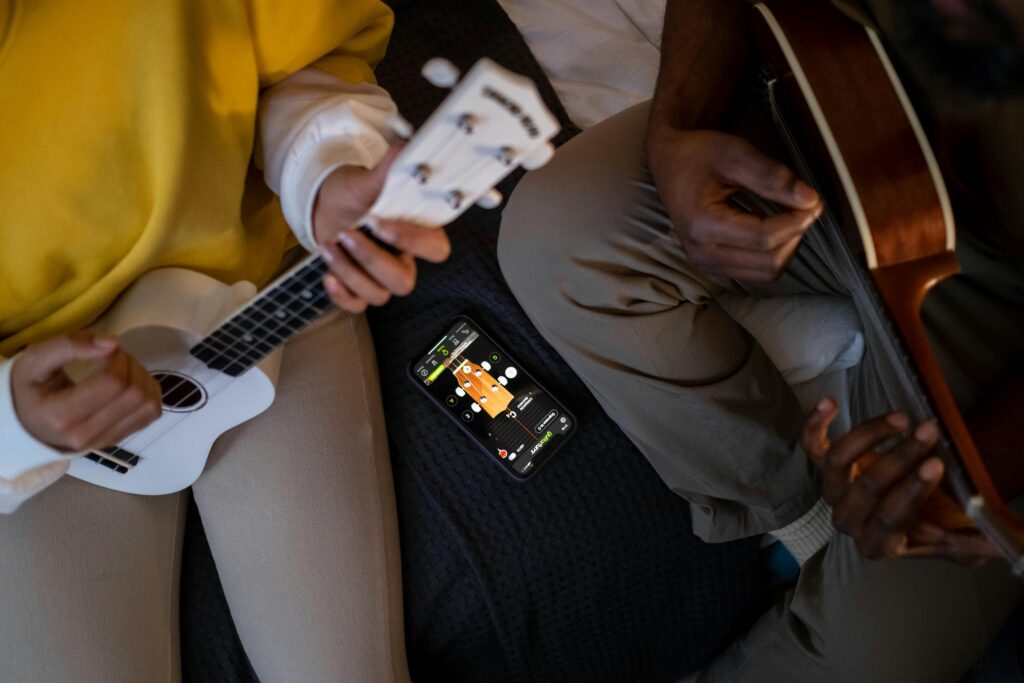
✨ The Future Sounds Bright
The technology powering guitar learning apps continues evolving rapidly. Artificial intelligence becomes increasingly sophisticated at analyzing playing nuances and providing personalized recommendations.
Augmented reality features may soon overlay finger positions directly onto your guitar through your device’s camera.
Virtual reality applications promise immersive learning experiences where you receive instruction in simulated environments or play virtual concerts for digital audiences. These innovations will make learning even more accessible, engaging, and effective.
What remains constant is the fundamental joy of creating music. Whether strumming simple chords around a campfire or mastering complex solos, the guitar offers lifelong rewards.
Modern apps simply remove barriers that once prevented countless people from experiencing these rewards.
Your musical journey begins with a single chord, a single strum, a single decision to start. With a quality guitar learning app as your guide, patient practice as your method, and genuine passion as your fuel, the guitarist you dream of becoming is entirely within reach.
The strings are waiting—it’s time to make them sing.
